Feet, teeth and staying upright
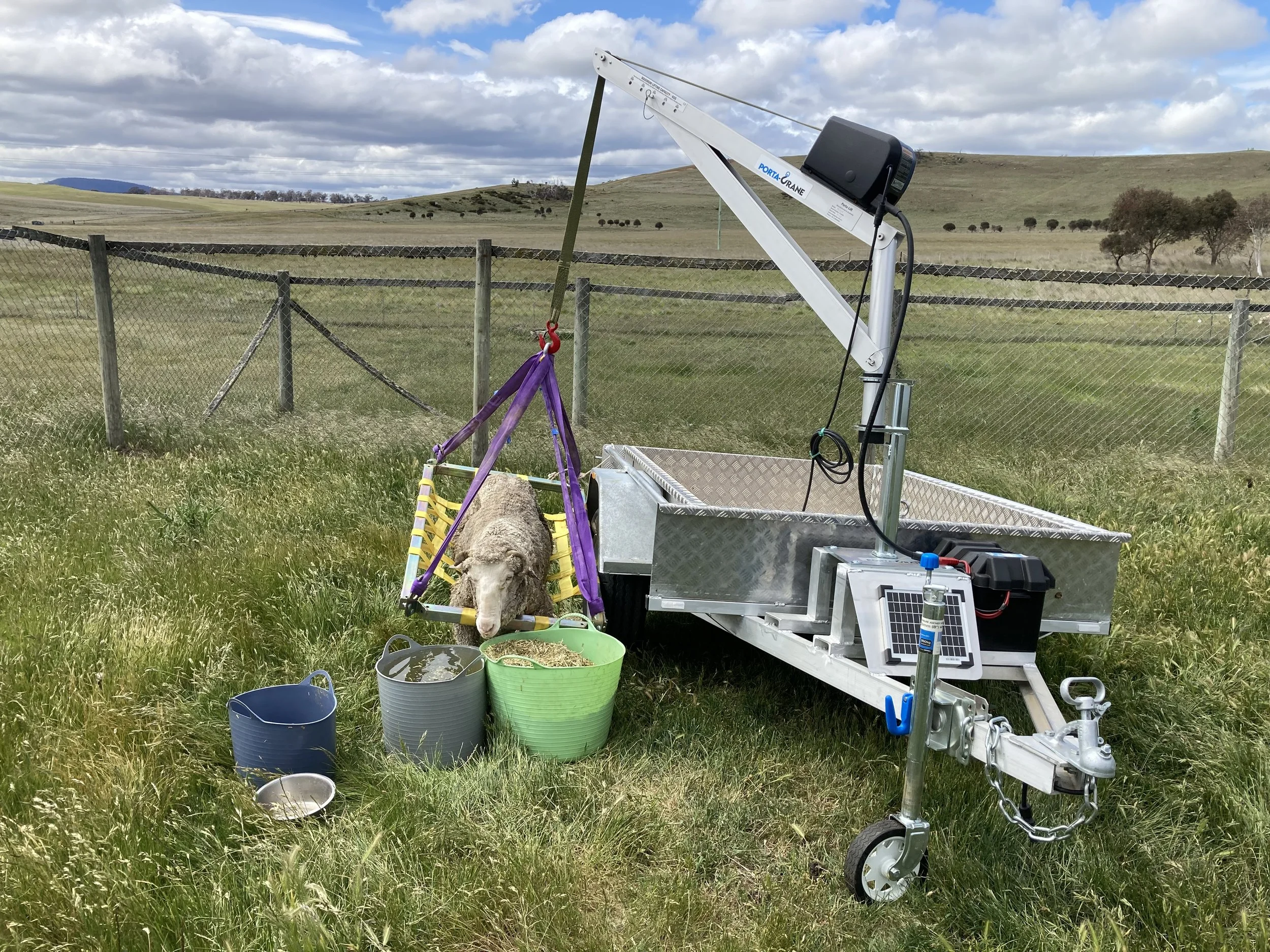
Cool Dude in the new fancy sling, operated with an electric crane, after being found cast in the paddock.
My life expectancy is between 81 and 86 years, depending on how you apportion the time I’ve lived in Australia (30 years) and the US (43 years). I’ll leave you to guess which country has the better statistic. My sheep have a life expectancy of about 14 years, based on the statistics I’ve been keeping for the past 10 years. If we translate sheep age, then, to human equivalent, my 12 year old sheep are my age. And guess what? We’re all having to do a better job of maintaining the integrity of our feet, teeth and balance.
The demographics of my flock are a moveable feast. When I stopped selling sheep 11 years ago, I moved from breeding 400 or so ewes each year to 30, because I no longer needed more lambs than I was likely to lose from my older sheep dying. To make it a bit tricky, though, I had no idea what the life expectancy of my sheep would be, and I wanted to hold the flock size constant. I took a guess at 50, and up until recently, it’s been more like 30 deaths per year. That’s about to change.
The last big lamb drop, in 2013, was 340 lambs, all of which I kept. They are now my 12-year-old baby boomers. Some have died prematurely, but the bulk of them are still going ok, including many of my pets and other named sheep: Clara, Vicki, Albert, Horatio, Leo, Leonard, Curly, Baxter and Prince. Together with the few remaining 13, 14, and 15-year-olds, the baby boomers make up more than half of my flock of 520 sheep. So I’m expecting the death rate in my flock to rise over the next 3 years, before dropping dramatically once the baby boomer generation is gone.
There were many unintended consequences of my abrupt decision to stop sending my sheep to slaughter, either directly or indirectly by selling them on. My decision was an emotional one, stemming from days on end spent shepherding my sheep in 2013-14, leading to the realisation that they’d become my friends. I simply didn’t want to put them on a transport truck. Ever again. Among those unforeseen consequences was the need to manage the ageing of my sheep in a way that ensured quality as well as quantity of years left to them. In the past year, the health issues in my baby boomers have brought this into particularly acute focus.
I have now instituted a few formal stages of care. I try to keep older sheep with the main flock as long as they are thriving. This is my equivalent to keeping older humans in their own home environment. I know how strong the social bonds are within the flock — both familial and friendships — and I don’t want to disrupt them. However, if a sheep is ‘cast’ (down and unable to get up on its own) in the paddock, and not found, it’s a death sentence whether the cause was misadventure or something organically wrong.
Lizzie as she was starting to stand on her own.
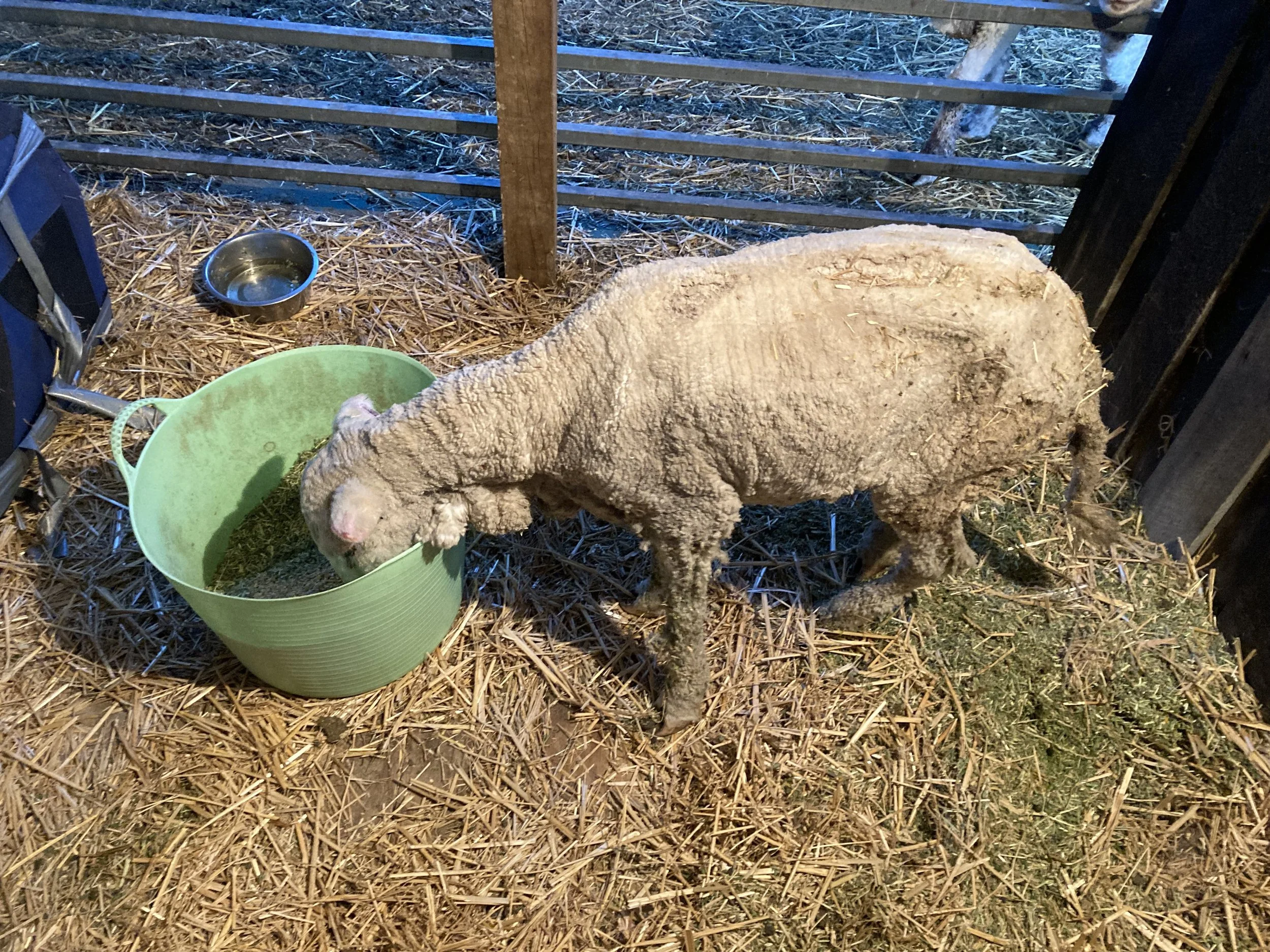

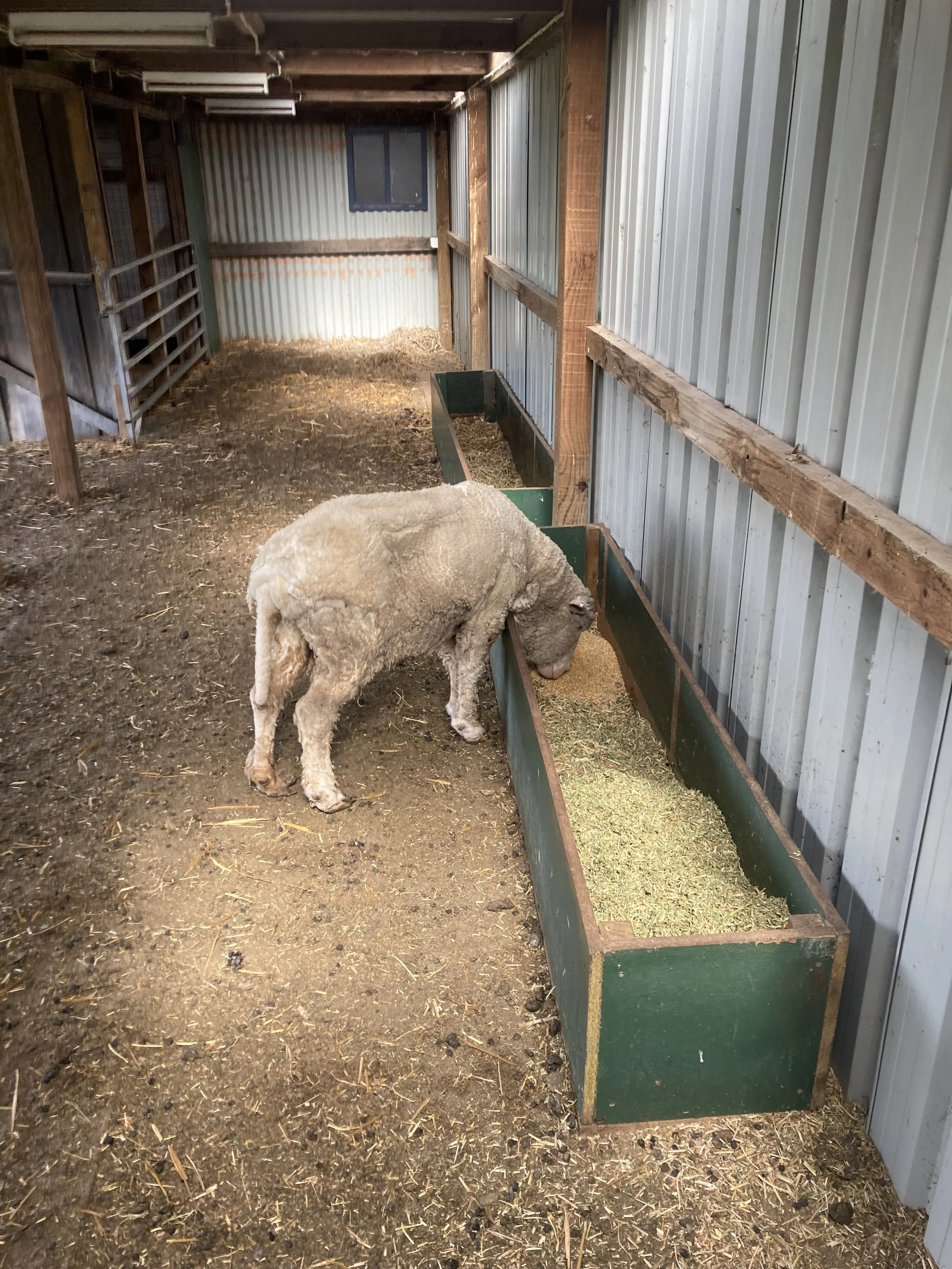
Left to right: Lizzie after a couple of weeks using the old sling for stability (outside in the sling during the day, in the pen at night); the pen set-up, with rubber mats on the floor for traction, to make it easier for her to get up on her own; Lizzie a few months later, looking in much better condition, and still addicted to cracked lupins! The whole recovery process took several weeks.
So, all cast sheep come in for an initial assessment and rehab if necessary. The misadventure ones often go back to the main flock. However, anybody who falls again or generally seems dodgy goes into either Independent Living, where they are seen most days, or Assisted Living, where they are seen, counted, and asked to get up and walk around if lying down, every day. Assisted living includes a spacious paddock with shade trees and a stable of sorts made by converting the old dog kennels. During winter, I feed a bit of lucerne hay and cracked lupins in feed bins in the stable, and the sheep love to congregate there, especially in a driving westerly storm.
This year I had more than the usual number of cast sheep, and started to suspect I might have Ovine Johnes Disease (OJD), an incurable bacterial infection of the gut that develops over a couple of years, and causes the sheep to waste away as they are unable to absorb the nutrients they need. There is a vaccine that is only known to be effective on sheep in their first year. I haven’t ever vaccinated for OJD, though I'm doing so now. The short version of this part of the story is that I do indeed have OJD in the flock based on blood tests, and have lost perhaps 10 sheep to it over this year. The good side of the story is that OJD forced me to set up a much more deliberate system for assessing the health of my older sheep, as the vet and I worked to figure out what was causing ill-thrift in some of my older sheep — whether OJD or other issues, including ageing.
My routine assessment of an older sheep now includes a teeth check, as poor front teeth can make it harder for sheep to grasp their bites of grass. Sheep only have lower front teeth, with what’s called a dental pad (bony gum) on the upper side. Generally, their molars stay healthy, but the more delicate front incisors of my 12-year-olds get a workout, with an estimated 25,000 bites per day! Over their 12 years, those teeth have bitten down 100 million times. In comparison, I’ve only bitten down something like 2 million times so far. We’ve recently checked the entire flock for teeth health, and have pulled out 23 to add to the 8 on whom we’ve already done dental work. That’s not a bad record considering the number of older sheep in the flock. I put it down to the good quality of nutrition as well as the good ground cover — my sheep are never biting dirt.
As it happens, a sheep is better off with no front teeth than with gappy ones, as the bony gums are perfectly able to grasp the softer, green grasses that are found on my farm. If there’s a gap, though, they struggle to get a good bite. Enter my vet, who comes to do ‘dental clinics’ where she uses both a local anaesthetic and long-acting pain relief to manage the impact of extracting those gappy teeth. I’ve been pleasantly surprised at how much improvement there is after dental work. A good case is Horatio, who was in poor condition, and I thought might well have OJD. He tested negative (thankfully) and is now apparently the flock leader, a role I think he’s coveted since he was a stroppy youngster!
Feet have a different, arguably more subtle effect on sheep health. As any ageing human will tell you, healthy feet are critical to well-being. Sheep in good forage walk 8 to 10 km a day, equating to perhaps 10,000 steps per day. The 12-year-olds, then have walked 40,000 km. (I think I’ve walked farther in my life — my estimate is 130,000 km — but I’m not sure how far I walked in the bad old days when I had a desk job. These days I walk my 10,000 steps most days!). Like my sheep, toenails are an issue for me, as is the balance of pressure and weight. I use orthotics to keep my feet level, but sheep need their toenails trimmed appropriately to get the weight distribution right: you want them on their toes, not back on their heels. This year, for the first time, I hired a professional to trim all the sheep’s feet, as I had become convinced that my amateur efforts were at best ineffective and possibly making things worse. He did a fabulous job, and I’ll be getting him back next year.
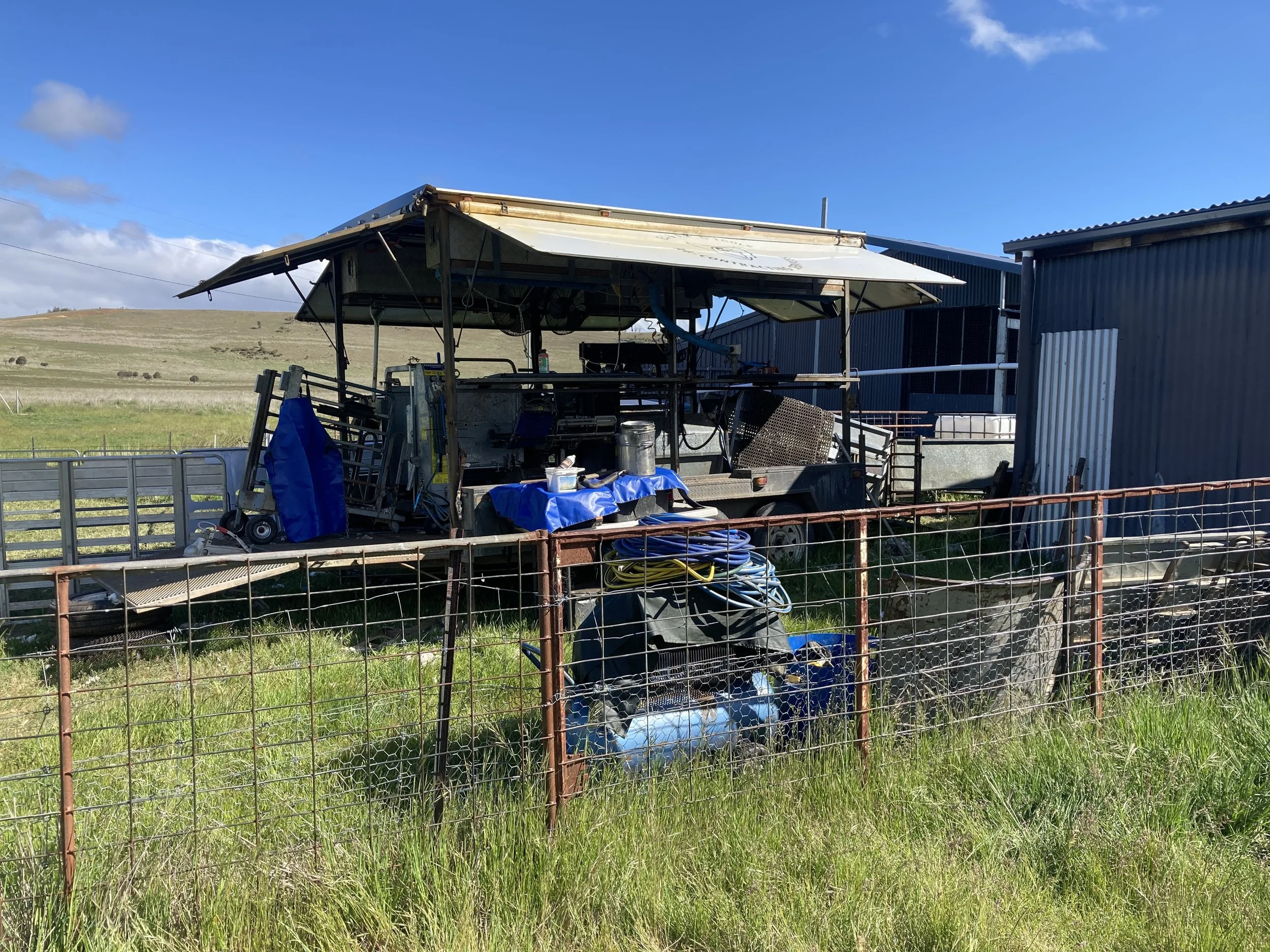
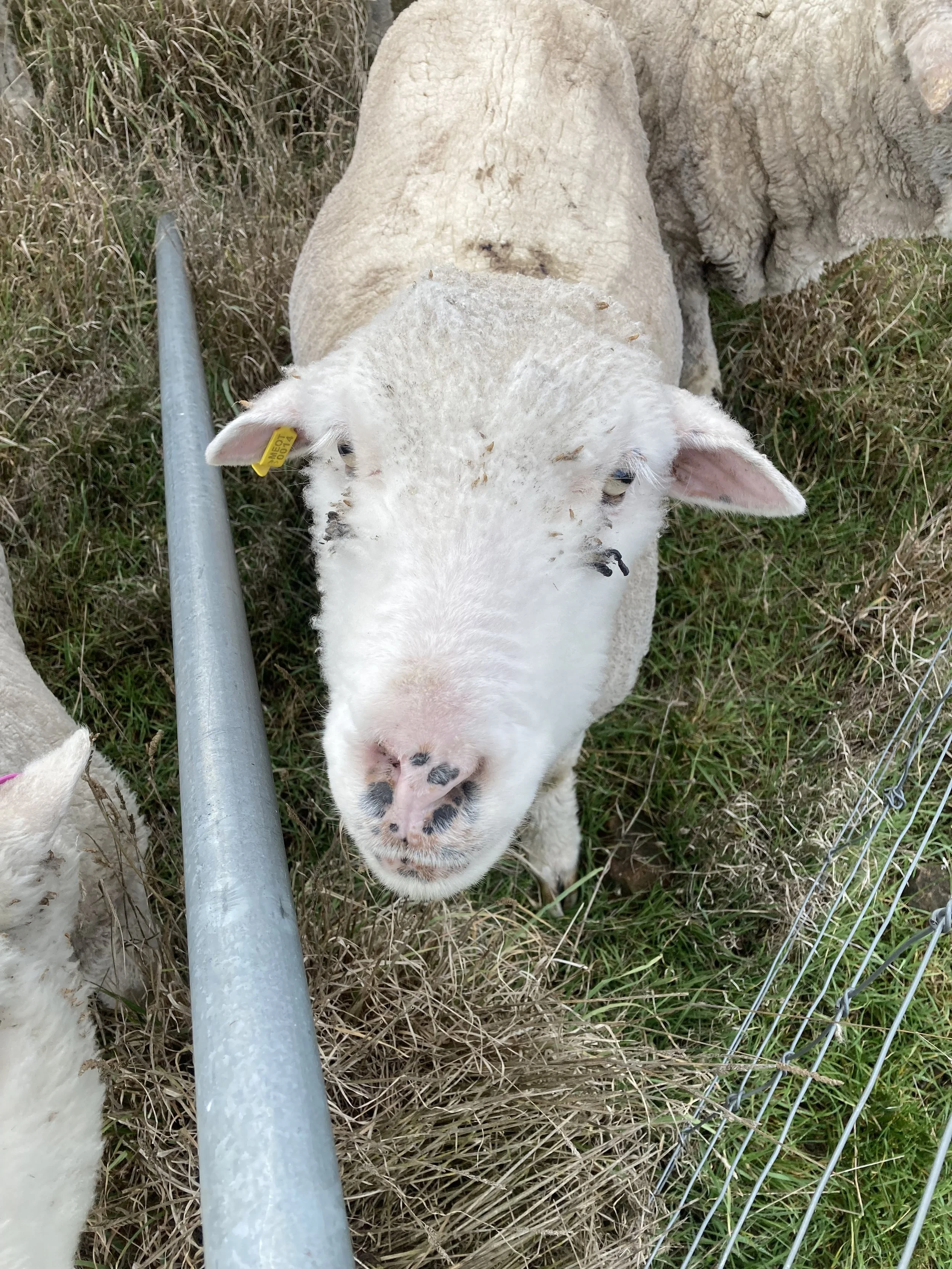
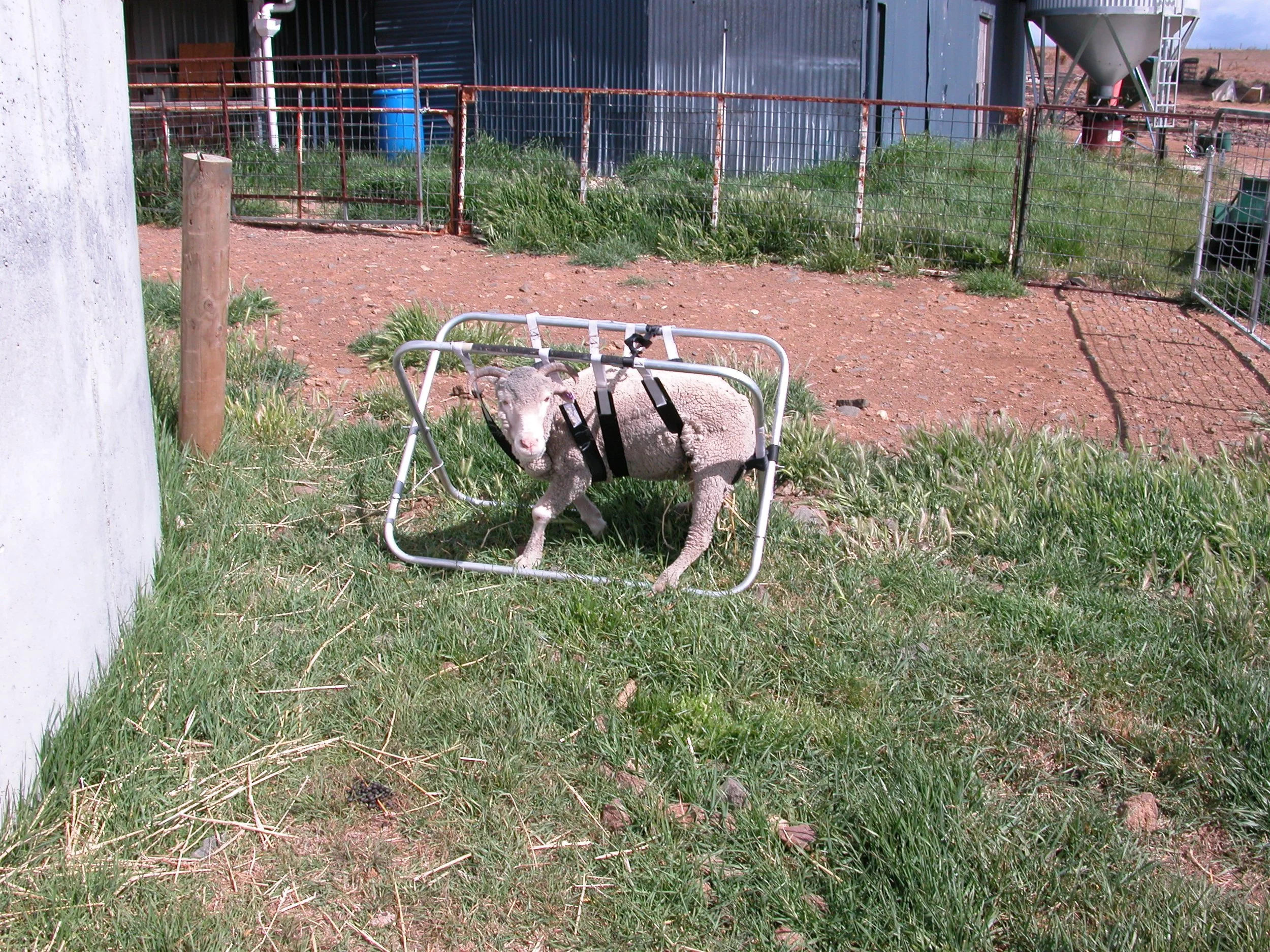
Left to right: the foot paring contractor’s trailer; Clara a few months after radical surgery to remove a cancer from her left nostril —so far, so good for no recurrence; Alice, the original rehab sheep, in the shiny new sling in 2006 when she was 2. Alice lived to the ripe old age of 15, spending her last days in assisted living.
Staying upright for sheep is, I suppose, the integration of good nutrition, functional teeth and balanced feet. Staying upright is the requirement for staying out of assisted living, and getting to continue to hang with your friends and relations. Just like us humans. There are unavoidable causes of death, like inoperable cancers, but if I can keep my sheep healthy and upright, they have every chance of making it to their 14 year life expectancy.
Cool Dude (aka Yellow 059), the sheep in the banner photo, heading out to join the assisted living mob after 5 days in rehab.